
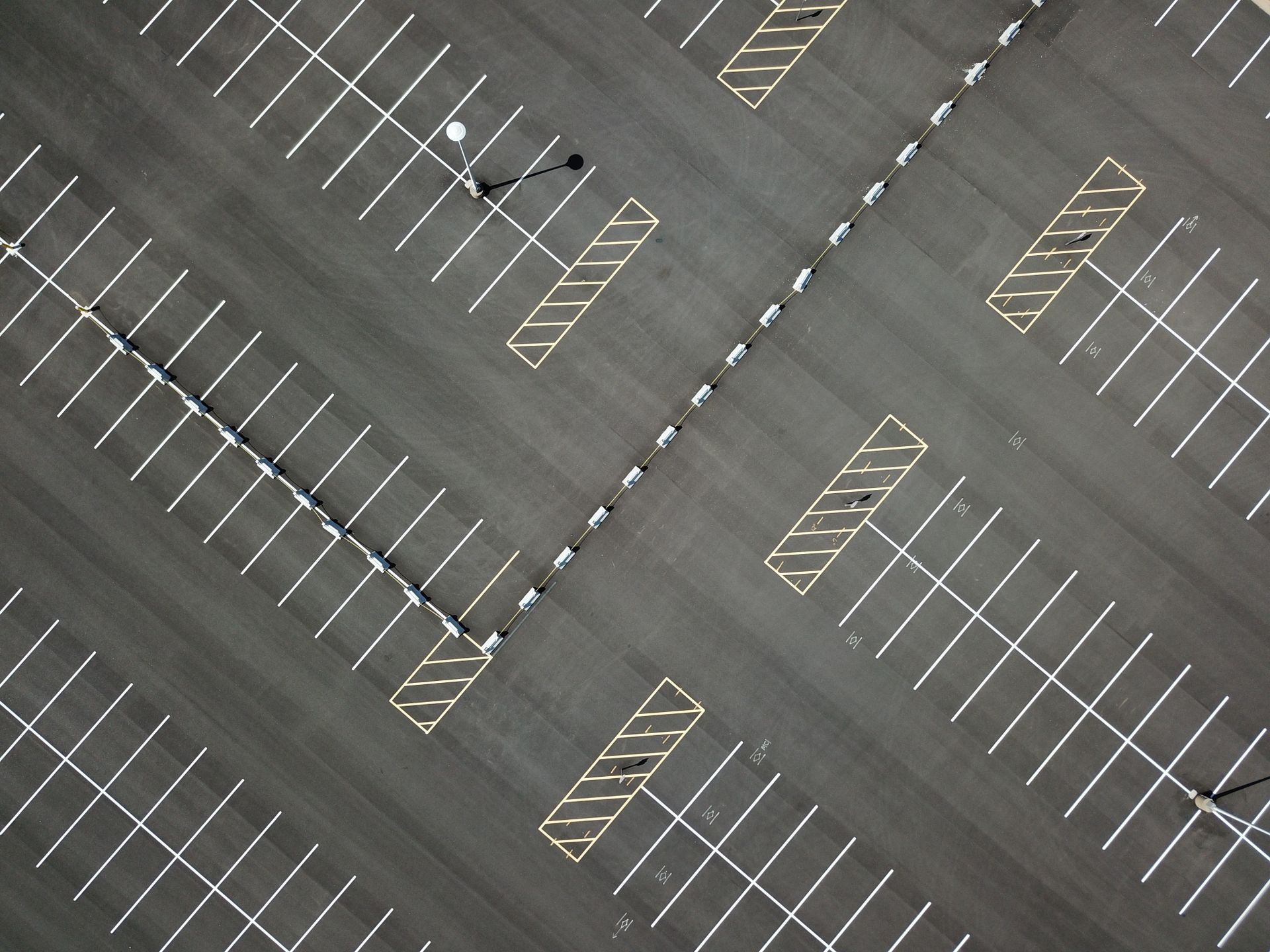
A faded handicap space isn’t simply an eyesore but a liability. For commercial parking lots, ADA-compliant striping requirements are not optional. The Americans with Disabilities Act sets clear requirements for accessible parking spaces, access aisles, signage, and pavement markings. Failing to meet them can result in complaints, fines, and costly lawsuits. In Atlanta, where commercial properties come in all shapes and sizes, getting your striping right is one of the most important things you can do to protect your business.
The ADA Sets Specific Rules That Every Commercial Lot Must Follow
The Americans with Disabilities Act has been the law since 1990, and its parking lot requirements are detailed and non-negotiable. Every commercial property open to the public is required to provide a minimum number of accessible parking spaces based on total lot size, and those spaces must meet exact dimensional standards. It’s not enough to paint a blue symbol on a regular-sized stall and call it done. The space, the access aisle beside it, the slope of the surface, and the signage all have to meet code.
What catches a lot of property owners off guard is that ADA compliance isn’t a one-time checkbox. Pavement markings fade over time, especially in Atlanta’s intense sun, and faded or obscured markings can make a previously compliant lot non-compliant. That’s why ADA pavement striping should be part of every parking lot maintenance cycle, not an afterthought. Staying current on your markings keeps you protected legally and signals to every visitor that your property is managed with care.
How Many Accessible Spaces Your Lot Actually Needs
The number of required accessible parking spaces is determined by your lot’s total parking capacity, and the ADA lays this out in a straightforward ratio. For lots with 1 to 25 total spaces, one accessible space is required. For lots with 26 to 50 spaces, two are required. From there, the ratio continues to scale up – 51 to 75 spaces require three, 76 to 100 require four, and so on. Larger lots follow a sliding scale that levels off at a percentage of total capacity.
Of those required accessible spaces, at least one in every six must be a van-accessible space. Van-accessible spaces have stricter dimensional requirements to accommodate vehicles with side-mounted wheelchair lifts. They need a wider access aisle, at least 8 feet, compared to the 5-foot minimum aisle required for standard accessible spaces. For commercial properties in Atlanta managing large lots, getting this math right matters and should be reviewed any time the lot is restriped or reconfigured.
Parking Lot Striping Dimensions Must Meet Exact ADA Standards
The dimensional requirements for ADA-compliant accessible spaces are specific, and getting them wrong, even slightly, can mean non-compliance. Standard accessible parking spaces must be at least 8 feet wide, with an adjacent access aisle that is at least 5 feet wide. That aisle must be clearly marked and kept free of obstructions at all times. The aisle is what allows wheelchair users and people with mobility devices to safely exit and enter their vehicles without being blocked by adjacent cars.
Here’s a quick reference for the key ADA striping requirements commercial lots need to meet:
- Standard accessible space width: Minimum 8 feet wide, with a 5-foot access aisle on one side marked with diagonal hatching.
- Van-accessible space width: Minimum 8 feet wide with an 8-foot access aisle, or alternatively 11 feet wide with a 5-foot aisle.
- Space length: Both standard and van-accessible spaces must be at least 18 feet long to accommodate full-size vehicles.
- Surface slope: The parking surface must have a slope of no more than 1:48 in any direction. Steep slopes make wheelchair use dangerous and are an ADA violation.
- Signage: Each accessible space must have a sign displaying the International Symbol of Accessibility mounted at least 60 inches above the ground, clearly visible from inside a vehicle.
- Van-accessible signage: Van-accessible spaces must include an additional ‘Van Accessible’ sign below the standard accessibility sign.
Location and Access Route Requirements Matter Just as Much
It’s not just about the size and markings of the spaces themselves, but where you put them matters, too. ADA regulations require accessible parking spaces to be located on the shortest accessible route to the building entrance they serve. That means if your building has multiple entrances, accessible spaces need to be distributed near each one, not all clustered in a single corner of the lot. Spaces also need to connect to the building via an accessible pedestrian route that is free of curbs, steps, and significant surface irregularities.
This is where a lot of older commercial properties in Atlanta run into trouble. A lot that was built and striped decades ago may have accessible spaces in technically legal locations that no longer make sense as the property has evolved because entrances moved, additions built, or traffic patterns changed. If your lot hasn’t been professionally assessed in a while, it’s worth having a contractor walk it with ADA compliance in mind. Catching and correcting location issues before a complaint is filed is always the better outcome.
Faded Markings Put You at Risk Even if You Were Once Compliant
One of the most overlooked ADA compliance risks for commercial property owners is marking degradation. Parking lot striping fades, and that’s a fact of life. Especially in Atlanta, where summer sun is relentless, and asphalt sealcoating cycles can wear surface paint faster than expected. A lot that passed inspection two years ago may have markings that are now too faint to clearly define accessible spaces, access aisles, and no-parking zones. Unclear markings create confusion, and confusion creates liability.
The practical fix is simple: include line restriping as a standard part of every parking lot maintenance cycle. Every time your lot gets sealcoated, typically every two to three years, a full restripe should follow. That keeps all markings crisp, ADA spaces clearly defined, and your property consistently compliant. It’s a relatively low-cost addition to a sealcoating job that eliminates a significant legal risk. Parking lot repairs and restriping go hand in hand for any well-managed commercial property.
Advanced Roofing & Paving Keeps Your Lot Compliant and Sharp
At Advanced Roofing & Paving, we handle full-service parking lot maintenance for commercial properties across Atlanta, including ADA-compliant striping, line restriping, asphalt sealcoating, and parking lot repairs. Our team knows the ADA standards inside and out and applies them on every job. We don’t just paint lines where you point, but make sure the layout, dimensions, and signage work together to keep your property compliant and your visitors properly served.
Whether you need a fresh restripe after a sealcoat, a compliance review of your current lot layout, or a complete overhaul of your accessible parking configuration, we’re equipped to handle it. We work efficiently to minimize disruption to your customers, and we communicate clearly every step of the way. When the job is done, you’ll have a parking lot that looks great, functions properly, and meets the standards your property is required to uphold.
Compliant Striping Protects Your Property and the People Who Use It
ADA compliance in your parking lot is about making sure your property is genuinely accessible to everyone who needs to use it. The requirements exist for good reason, and meeting them consistently is part of being a responsible commercial property owner in Atlanta. Faded lines, undersized spaces, and missing signage are all fixable problems, as long as you stay on top of them before they become complaints or citations.
Ready to make sure your parking lot is fully ADA-compliant? Contact Advanced Roofing & Paving today for a professional assessment. Our team will walk your lot, review your current striping and signage, and give you a clear picture of what’s needed to bring everything up to standard. Don’t leave your property exposed, so reach out now and let’s get it squared away.